How Long Does the Provincial Nominee Program Take?
2. Provincial Nominee Program (PNP)
Each Canadian province has its own Provincial Nominee Program to meet local labor market needs.
There are two types:
- Base PNP (paper-based)
- Express Entry-linked PNP (online)
Average Processing Time:
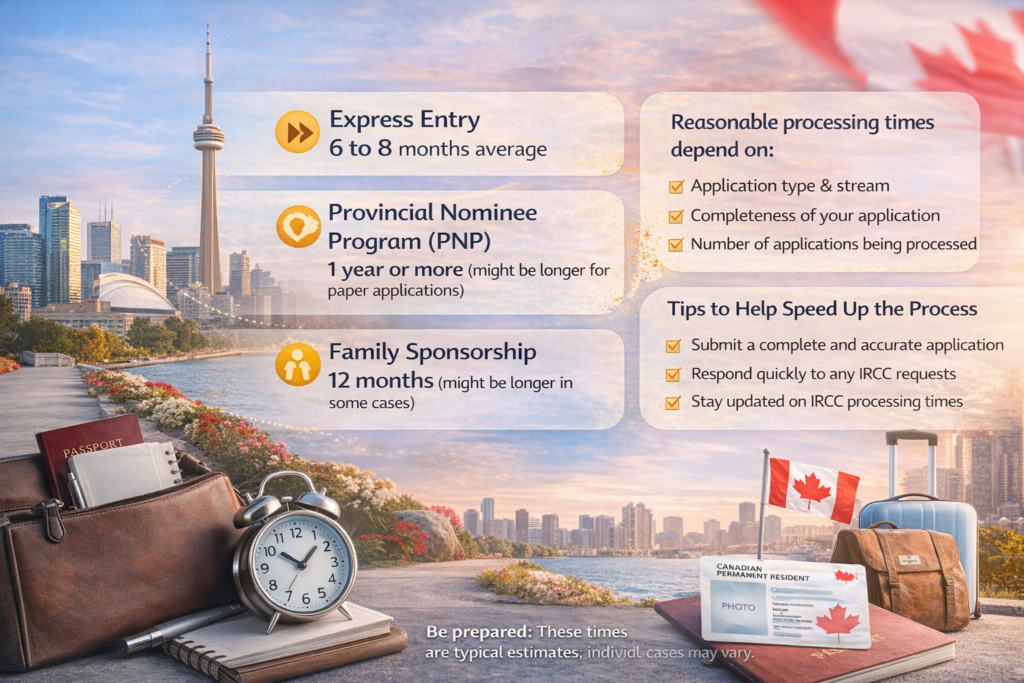
- Express Entry-linked PNP: 6–9 months
- Base PNP: 12–20 months
The timeline includes two stages:
- Provincial nomination (2–6 months depending on province)
- Federal PR processing by IRCC
Express Entry-linked PNP is generally faster because it uses the federal online system.
Also read: Open Work Permit Extension Helps TR to PR Applicants in Canada
How Long Does Family Sponsorship Take?
3. Family Sponsorship
If you are being sponsored by a spouse, common-law partner, dependent child, or parent, processing times differ.
Spouse Sponsorship:
Approximately 12 months
Canada prioritizes family reunification, so spousal applications are usually processed within one year.
Parent and Grandparent Sponsorship:
20–24 months or more
Due to high demand and annual quotas, processing can take longer.
How Long Does PR Take Through Study or Work Permit?
Many immigrants first come to Canada on a study permit or work permit and later apply for PR.
Study Permit to PR
If you study in Canada and gain Canadian work experience, you may qualify under Canadian Experience Class (CEC).
Timeline:
- 1–2 years of study
- 1 year of work experience
- 6 months for PR processing
Total timeline: 2–4 years
Work Permit to PR
If you are already working in Canada under a valid work permit, you may qualify for Express Entry or PNP.
PR processing itself: 6–8 months
Factors That Affect PR Processing Time
Even though IRCC provides estimated timelines, several factors can impact your application:
1. Completeness of Application
Missing documents can cause delays or refusals.
2. Background & Security Checks
Applicants undergo criminal and security screening, which may take longer depending on travel history.
3. Medical Examinations
Medical clearance is mandatory and can delay applications if additional tests are required.
4. Volume of Applications
Processing times may increase during peak immigration targets or policy changes.
5. Country of Residence
Some visa offices have longer processing queues than others.
Current Official Processing Times
The most accurate and updated processing times are published by Immigration, Refugees and Citizenship Canada on their official website. Processing times are regularly updated based on real-time data.
As of recent updates:
- Express Entry: ~6 months
- Spouse Sponsorship: ~12 months
- PNP (paper-based): 12–20 months
Keep in mind that these are averages, not guarantees.
Also read: 10 Happiest Cities in Canada and Why Residents Love Them
How Long Does It Take After Biometrics?
After submitting biometrics (fingerprints and photo), applicants often wonder how much longer the process will take.
There is no fixed timeline after biometrics. Some applicants receive decisions within 2–3 months, while others may wait longer depending on background checks.
Biometrics is just one part of the overall screening process.
Can You Speed Up Canada PR Processing?
Unfortunately, there is no official way to fast-track your PR application unless you qualify under special categories like Global Talent Stream (for work permits) or humanitarian grounds.
However, you can avoid delays by:
- Submitting complete and accurate documents
- Ensuring police clearance certificates are valid
- Completing medical exams promptly
- Monitoring IRCC messages regularly
- Responding quickly to additional document requests
Hiring an experienced immigration consultant can also help reduce errors that may delay processing.
What Happens After PR Is Approved?
Once approved, you receive:
- Confirmation of Permanent Residence (COPR)
- Permanent Resident Visa (if applicable)
You must then land in Canada before the expiry date on your visa or COPR.
After landing, your PR card is mailed to your Canadian address, usually within 2–3 months.
Realistic Timeline Summary
Immigration Pathway — Estimated Time
- Express Entry — 6–8 months
- Express Entry + PNP — 6–9 months
- Base PNP — 12–20 months
- Spouse Sponsorship — ~12 months
- Parents Sponsorship — 20–24+ months
- Study to PR — 2–4 years total
Why Timelines Change Frequently
Canada sets annual immigration targets through its Immigration Levels Plan. When targets increase, processing may speed up. When application volumes exceed capacity, delays may occur.
The COVID-19 pandemic also showed how global events can impact immigration timelines.
Therefore, while estimated processing times give a general idea, flexibility and patience are important.
Final Thoughts
So, how long does it take to get Canada Permanent Residency? For most skilled workers applying through Express Entry, the process typically takes around 6 to 8 months after submitting a complete application. However, total timelines can range from several months to a few years depending on the immigration pathway you choose.
The key to faster processing is preparation, accuracy, and choosing the right immigration stream based on your profile. Staying informed through official updates from Immigration, Refugees and Citizenship Canada can also help you plan your journey effectively.
Canada remains committed to welcoming newcomers, and with proper guidance and planning, your PR journey can be smoother and more predictable.
If you’re considering applying for Canada PR, understanding timelines is the first step toward building your future in one of the world’s most welcoming countries.